
A kettlebell workout is one of the best ways to get strong, sweaty and slightly smug in 20 minutes. Three moves cover most of what a beginner needs: the swing, the goblet squat and the Turkish get-up. Learn them well and you have a gym in a single handle.
Below is how to do each one, how heavy to go and a short session to try this week. If any move hurts or something feels off, stop and ask a coach. Talk to your doctor first if you have an injury or a health condition.
Why kettlebells are worth your time
A kettlebell's weight hangs below the handle, so it asks you to control it in ways a dumbbell doesn't. That makes the swing a great hip and glute exercise and the get-up a lesson in shoulder stability. A Nuffield Health guide to the five essential kettlebell lifts lists the swing for the back, hips and posterior chain, the squat for legs, back and core, and the Turkish get-up, which it classes as advanced, for shoulders, core, triceps, glutes and legs. They're all full-body, which is the point.
The kettlebell swing
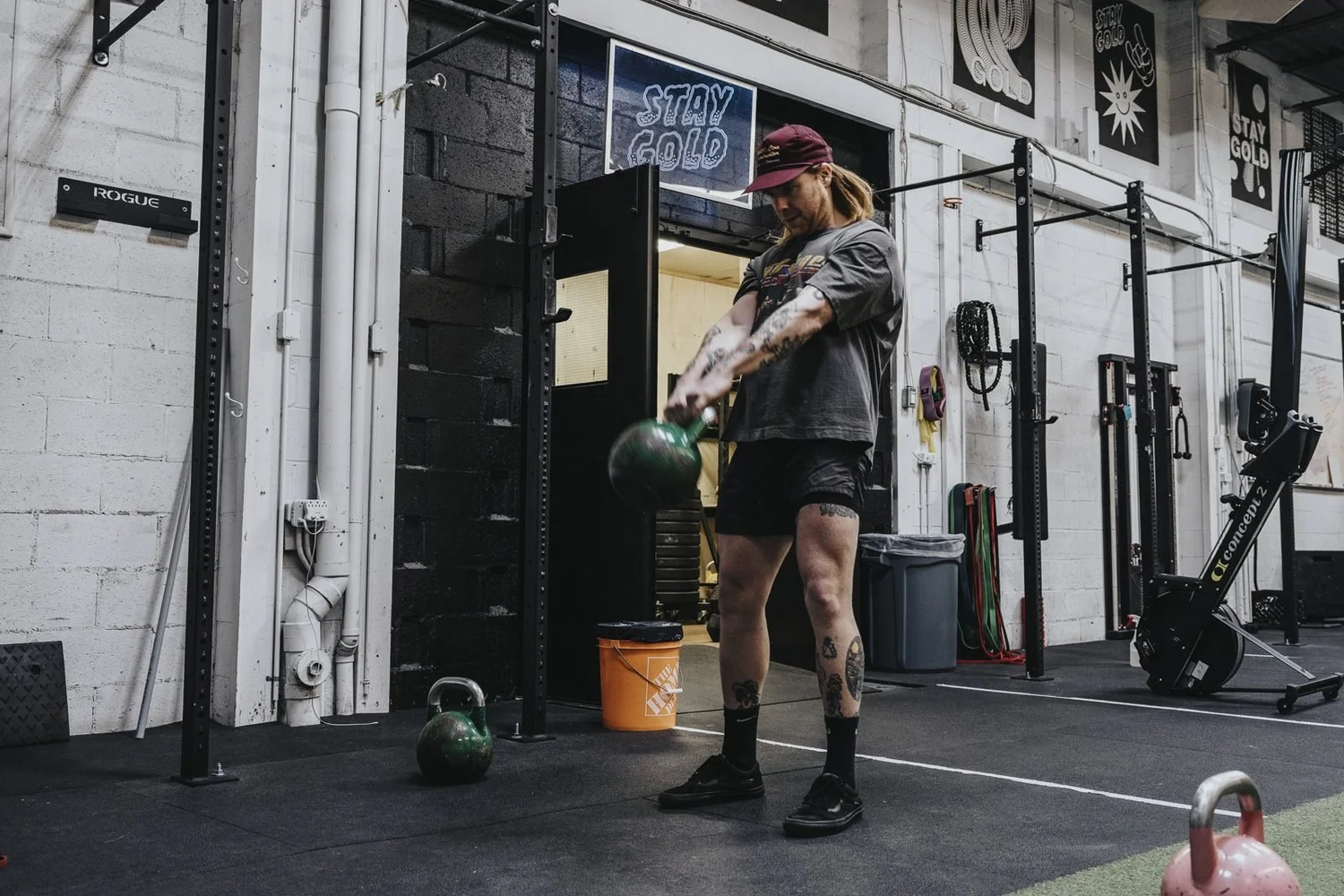
The swing is a hinge, not a squat. Your hips go back, the bell goes between your legs, and then your hips snap forward to float the bell to chest height. Your arms are along for the ride.
- Stand about shoulder-width apart with the bell a foot or so in front of you.
- Hinge at the hips, push your bottom back, and grab the handle with both hands. Your back stays flat.
- Hike the bell back between your thighs, like you're passing a football.
- Drive your hips forward and stand tall. The bell rises on its own.
- Let it fall, hinge again, repeat.
The Nuffield guide's cue for the swing is to keep your spine neutral and drive your hips forward to bring the bell to shoulder height, starting with a lighter bell. We'd add: if your lower back is doing the work, you're lifting with your arms or back instead of snapping the hips. Reset and slow down.
The goblet squat
Hold the bell by the horns, close to your chest, elbows pointing down. Squat down between your knees with your chest tall, then stand up through your whole foot. The weight out front helps your torso stay upright, which is why it's such a good teaching squat.
- Feet about shoulder-width, toes slightly turned out.
- Sit down between your hips, don't fold forward.
- Elbows can brush the inside of your knees at the bottom.
- Drive through the legs on the way up. The Nuffield piece puts it simply: focus on driving up through the legs with each rep.
The Turkish get-up
This is the slow one. You go from lying on the floor to standing with a kettlebell locked out overhead, then reverse it. It looks like a party trick and is actually a very honest test of shoulder control, core strength and patience.
The Kettlebell Kings get-up guide breaks it into stages: roll, press the bell overhead, come up to the forearm, then the hand, bridge the hips, sweep the leg back, lunge and stand. Its main advice: go light and stabilize each position before you move on to the next one. We agree. Start with no weight, or a shoe balanced on your fist, until the sequence is smooth. Then add a bell.
How heavy should a kettlebell be?
Common starting points are around 8 to 12 kg for many women and 12 to 16 kg for many men on swings, with lighter for presses and get-ups. That's a general starting range, not a rule. The right weight is the one that lets you keep clean form and finish all your sets feeling like you've worked but not wrecked. If you're brand new, a lighter bell with great form beats a heavy one with a rounded back every time.
A simple 20-minute kettlebell workout
Warm up for five minutes first: bodyweight squats, hip hinges, arm circles. Then:
- 10 rounds, every minute on the minute: 10 swings. Rest whatever's left of the minute.
- 4 sets: 8 goblet squats, with 60 seconds rest.
- 3 sets: 2 get-ups per side, no rush, light bell.
Do it twice a week for a month. Add a few reps, or a slightly bigger bell, when it starts to feel easy. This fits nicely into the CSEP 24-hour movement guidelines' recommendation of muscle strengthening at least twice a week.
Learn it with a coach
Kettlebells are a lot easier to learn with someone watching. Form feedback in the first few sessions saves you from bad habits that take months to unlearn. At Stay Gold, our Gold Standard strength and conditioning class is coached, and small group training is capped at 8, so you won't get lost. If you want a one-on-one session to dial in the swing, personal training is a good fit. New to the gym? The beginners page is the place to start.
Quick answers
Is a kettlebell workout good for beginners?
Yes, if you start light and learn the hinge first. The swing and goblet squat are beginner-friendly, and the get-up is best saved for when you're comfortable with the basics.
How many times a week should I do kettlebell workouts?
Two to three times a week works well. It covers the guideline of strength training at least twice a week and leaves recovery days.
What's the difference between a swing and a squat?
A swing is a hip hinge that snaps forward, and a squat bends the knees and sits down between the hips. They train different patterns, and mixing them up is the most common beginner mistake.
Can kettlebells replace the gym?
For many people, a couple of bells covers a lot. But a coached gym adds variety, progression and someone who can spot problems in your form.
Learn kettlebells with a coach
Get form feedback in a small class. Free tour or pass.