
If you work at a desk, your body is probably telling you about it: tight hips, a stiff upper back, shoulders creeping toward your ears, a neck that crunches when you turn it. Good mobility for desk workers isn't complicated. It's about breaking up the sitting and giving your joints a reason to move.
This post covers why it happens, what Canadian workplace guidance says to do about it and a simple 10-minute routine you can do at home, at the gym or in a corner of the office when nobody's looking. Whether your desk is in Liberty Village, downtown, on Roncesvalles or at the kitchen table, it applies.
Why sitting all day makes you stiff
Your body adapts to what you do most. Hours in a chair means hip flexors that stay short, glutes that stop firing, a rounded upper back and shoulders that drift forward. None of this is dramatic on any single day. It's the cumulative effect that leaves you feeling like a folding chair.
The Canadian Centre for Occupational Health and Safety (CCOHS) is blunt about it. Its sitting overview links prolonged sitting to back pain, metabolic syndrome, heart disease and poor mental health, and notes that sitting reduces blood flow to working muscles and puts steady strain on the neck, lower back and spinal discs. It also says poor body position is the main cause of harm, and that changing position often is part of the answer.
What the guidance says to do
CCOHS has two practical numbers worth keeping. Its stretching at the workstation page recommends a break of 5 to 10 minutes for every hour at a workstation, ideally standing and walking, or at least changing position. And the sitting page suggests five minutes of moderate to vigorous activity, such as walking, for every 40 to 50 minutes of sitting.
It also suggests holding each stretch for about 10 to 20 seconds while breathing normally, never bouncing or forcing a stretch, and stopping if you feel pain. You should feel a stretch, not pain. Good rules.
Mobility for desk workers: a 10-minute routine
Do this once a day, or split it into two five-minute chunks. Move slowly. Breathe.
1. Hip flexor stretch (kneeling lunge), 30 to 45 seconds per side
Kneel on one knee, tuck your tailbone under and gently shift forward until you feel the front of the back hip. Keep your ribs down. If it's tight, a folded towel under the knee helps.
2. Glute bridge, 2 sets of 10
Lie on your back, feet flat, and squeeze your glutes to lift your hips. Pause at the top for two seconds. This wakes up the muscles that go to sleep in a chair.
3. Thoracic rotation (open book), 8 per side
Lie on your side with knees bent, arms out in front. Open your top arm toward the other side, following it with your eyes. This frees up the upper back.
4. Cat-camel, 10 slow reps
On hands and knees, round your back, then arch it. Move one vertebra at a time, like you're counting them.
5. Wall slides, 10 reps
Stand with your back and arms against a wall, elbows bent. Slide your arms overhead and back down without letting your ribs flare. Many desk workers find this harder than it looks.
6. Chest and neck release, 20 seconds each
Stand in a doorway, forearms on the frame, and lean gently forward to open the chest. Then drop one ear toward your shoulder for a gentle neck stretch on each side. Stay in the comfortable range.
Little changes at your desk
- Set a timer. Every 45 to 50 minutes, stand up and walk for a few minutes.
- Change positions. Stand for a call, perch on the edge of a chair, pace a hallway.
- Look away. CCOHS suggests looking at a distant object during breaks to rest your eyes.
- Take the stairs or walk to a colleague. Replace the message with a stroll.
If you have pain, numbness or tingling that doesn't go away, see your doctor or a physiotherapist rather than stretching through it.
Mobility is not the whole answer
Stretching helps, but strength is what keeps a better position. Glutes, upper back and core are the muscles that hold you up while you sit. Strength training builds them, and the CSEP 24-hour movement guidelines recommend muscle strengthening at least twice a week for adults. A mix of mobility and strength is the best answer for a body that spends its day in a chair.
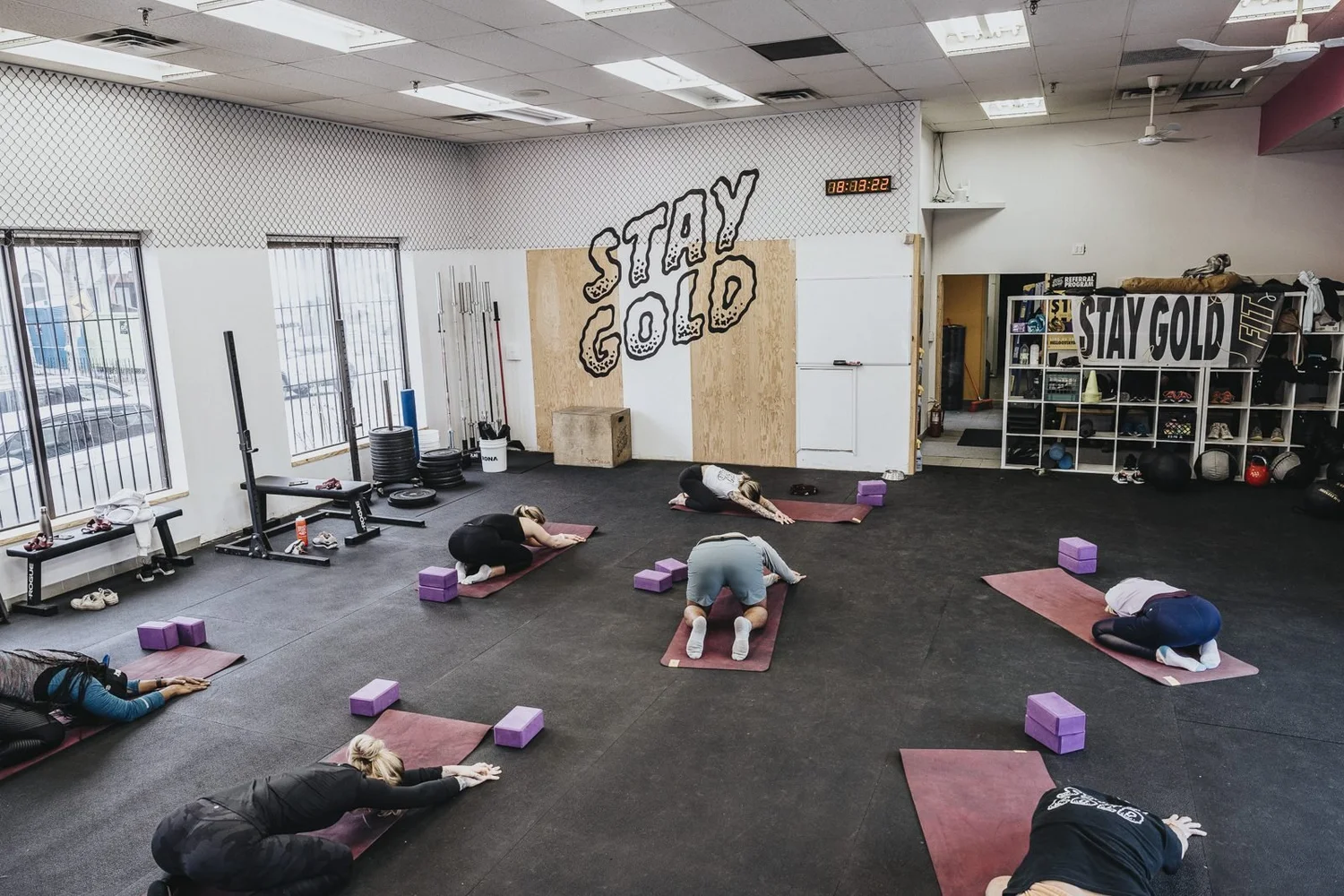
At Stay Gold, Liquid Gold is our mobility class, and Golden Hour is Pilates-style full-body strength. Both are on the classes page. If you're after more long-term movement health, the longevity page and recovery page explain how we think about it. New to training? The beginners page is a gentle on-ramp.
Quick answers
How often should desk workers take movement breaks?
CCOHS recommends a 5 to 10 minute break for every hour at a workstation, and about five minutes of moderate to vigorous activity for every 40 to 50 minutes of sitting.
What stretches help after sitting all day?
Hip flexor stretches, glute bridges, thoracic rotations and wall slides target the areas that tighten and weaken most. Go slowly and stay out of pain.
How long should I hold a stretch?
About 10 to 20 seconds while breathing normally, according to CCOHS. Don't bounce or force it.
Is mobility enough to fix desk posture?
It helps, but strength training and regular movement breaks matter too. If you have persistent pain, talk to a doctor or physiotherapist.
Move better, sit less
Try Liquid Gold mobility at Stay Gold. Free tour or pass.