
If you've signed up for a HYROX Toronto race and your date is about six weeks away, this is the stretch where the race gets built or wasted. Six weeks is enough time to make real gains, and short enough that every week matters.
This post assumes you already have a base: you've been training for a while, you've done some HYROX-style workouts and you're not brand new to running or lifting. If you're starting from zero, our HYROX and DEKA page is a better first stop. Check hyrox.com for your race date and division, because details change by season.
HYROX Toronto race prep: the big picture
The race itself, per the HYROX race page, is eight 1 km runs, each followed by a station: SkiErg, sled push, sled pull, burpee broad jumps, rowing, farmers carry, sandbag lunges and wall balls. Training for it comes down to three things in the last six weeks:
- Race-specific fitness: being able to run, then work, then run again.
- Pacing: knowing what effort you can hold for roughly an hour or more.
- Freshness: arriving rested, not buried.
Everything in the plan serves those three.
Week by week
Weeks 6 and 5: build
This is your biggest training load. Three to four runs a week, including one long easy run and one session of intervals (for example 6 x 800 m at a hard but repeatable pace). Two strength sessions focused on squat, hinge, lunge and carry patterns. Once a week, a combined session: 1 km run, station, 1 km run, station, for four rounds. Keep stations at race weights or slightly below.
Week 4: the big simulation
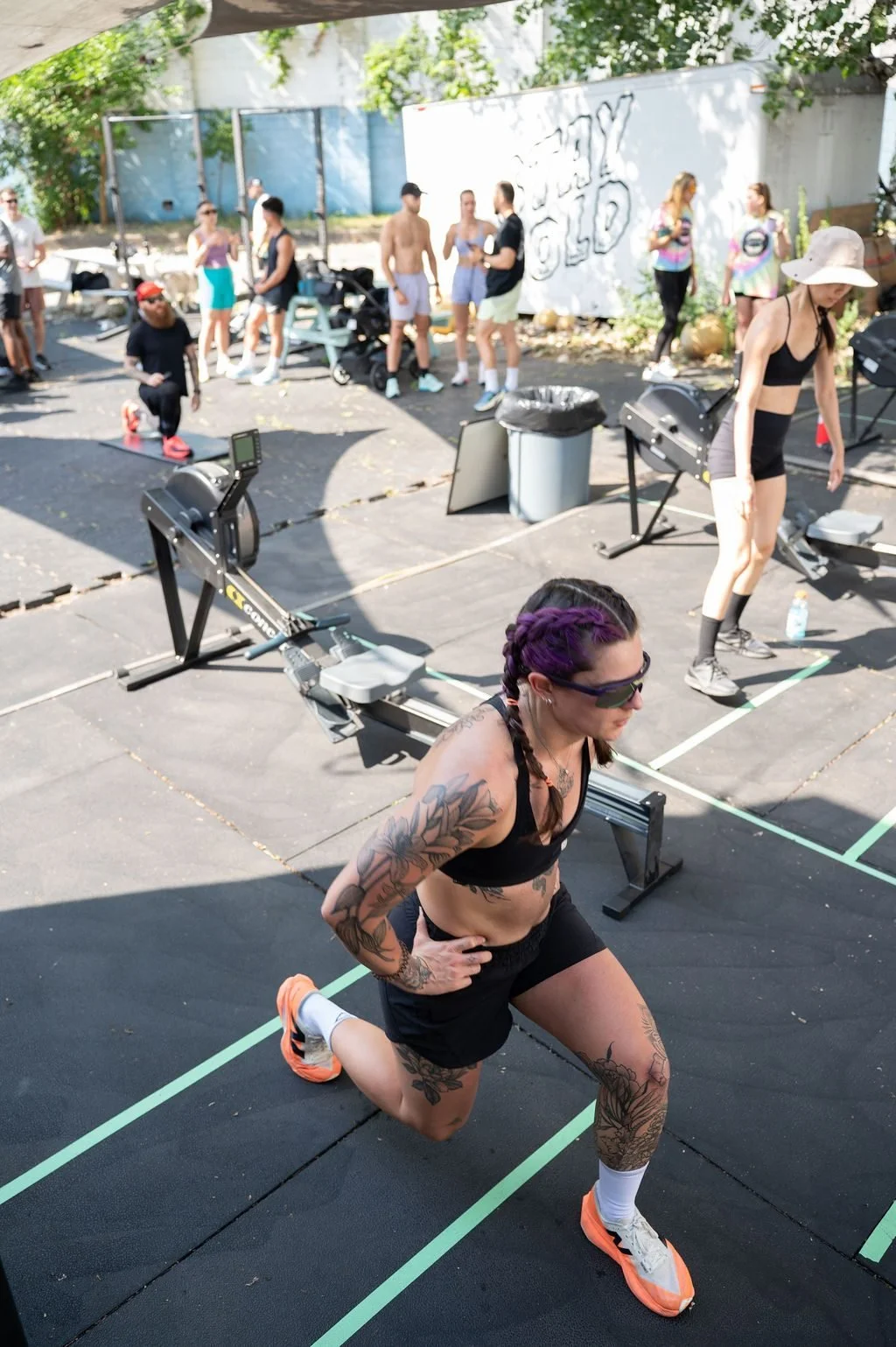
This is the one to circle. Do a long session that looks like the race: a Half HYROX simulation (four runs and four stations) or a full run-through if you're feeling strong. At Stay Gold we host Half HYROX simulations and HYROX PFTs, which are a good way to find out where you stand with a crowd, a clock and the music up. Write down your splits for every run and station. You'll learn more from that page of numbers than from three weeks of guessing.
Week 3: sharpen the weak spot
Look at the splits. Where did you lose the most time? Wall balls, sled pull or the last two runs? Spend this week fixing it. If wall balls cost you, practise unbroken sets of 15 to 20 with short rests. If runs 7 and 8 fell apart, add some easy-pace volume and make sure you're fuelled in training.
Week 2: hold fitness, cut volume
Drop total volume by about a quarter. Keep one more race-pace session, shorter than before: two or three rounds of run-and-station at target effort. Keep strength steady but lighter. This is where people panic and add extra work. Don't.
Week 1: taper
Cut volume by roughly 40 to 50 percent. A couple of short, sharp efforts keep your legs alive. Sleep, eat enough carbs and get a good mobility session in. If you feel antsy, that's the taper working.
Pacing the actual race
Run the first kilometre like it's the first of eight, because it is. Aim for a pace you could chat at, then hold it. Your target on the runs should be steady, not heroic. On the stations, plan your breaks before you're forced to take them: wall balls in sets of 20 to 25, lunges in chunks and the sled in controlled pushes. The race rewards smooth over spiky.
Fuel, sleep and recovery
The last six weeks are as much about what you do outside the gym as inside it. A few things worth protecting:
- Sleep. The CSEP 24-hour movement guidelines recommend 7 to 9 hours of good-quality sleep for adults. In the last two weeks, protect it.
- Practise your race-day food. Whatever you plan to eat and drink, test it in your hard sessions. Nothing new on race day.
- Manage the small stuff. Mobility, easy walks and a day off here and there. Your body will thank you.
- Listen to pain. Soreness is fine. Sharp or lingering pain isn't. Talk to a doctor or physio if something's off.
Train with a crowd
HYROX is more fun and a lot less lonely when you're not doing it alone. As an official HYROX Training Club and DEKA affiliate, we run HYROX and DEKA training classes, and our small group training is capped at 8 so coaches can watch your form on the sled and the wall balls. If you'd like a plan built for your date, personal training works well for the final stretch.
Quick answers
How many weeks do I need to prepare for HYROX?
Most people with a base of fitness benefit from 8 to 12 weeks. The final six weeks are where you sharpen race-specific fitness and taper.
Should I do a full HYROX simulation before race day?
A Half HYROX simulation about three to four weeks out is plenty for most people. A full simulation is a heavy hit, so be careful with timing.
How do I taper for HYROX?
Reduce volume in the last two weeks, keep a few short efforts at race pace and prioritize sleep and food.
Where can I find HYROX Toronto dates?
Check hyrox.com for this season's calendar, locations and registration.
Prep with the pack
HYROX classes, simulations and coaching. Free tour or pass.